Understanding the Main Treatment Technologies
Ozone is a powerful oxidizer and disinfectant capable of reducing bacteria, viruses, odours, colours, iron, manganese, and certain organic contaminants. However, it does not remain in water for long; it decomposes into oxygen, which means it provides no lasting protection in storage tanks or pipes. Additionally, using ozone increases equipment costs, maintenance requirements, electrical demand, and safety considerations. Therefore, ozone should typically be used only when there is a specific need, such as for odour control, colour removal, the oxidation of challenging contaminants, or advanced treatment processes. A guide to assessing these specific needs can help engineers select processes.
UV disinfection is a widely used method for inactivating bacteria, viruses, and protozoa. It operates quickly by damaging the DNA or RNA of microorganisms as water flows through the UV chamber. This method is particularly beneficial because it involves no added chemicals and is effective against organisms that are more resistant to chlorine, such as Cryptosporidium and Giardia.
While UV treatment has its advantages, it also comes with limitations. It does not eliminate physical or chemical contaminants, soften water, or remove metals, salts, PFAS, or other dissolved pollutants. Additionally, UV systems require clear water to function effectively. If the water is cloudy or contains suspended solids, iron, or high turbidity, microorganisms may be shielded from the UV radiation. Therefore, proper and effective pre-filtration is crucial. Lastly, UV systems need electricity and require routine lamp replacement and cleaning.
Chlorine is still widely used in water treatment because it offers something that UV light and ozone do not: residual protection. A small amount of chlorine can remain in the water after treatment, helping to prevent re-contamination as the water moves through tanks, pipes, and distribution systems. This is particularly important when water is stored for uses like toilet flushing or irrigation. Although chlorine is relatively inexpensive, it needs to be carefully dosed. Using too much chlorine can lead to byproducts, unpleasant odors, corrosion, and adverse effects on plants and soil.
Is Ozone + UV + Chlorine Always Necessary?
In most cases, using ozone, UV, and chlorine together is a premium multi-barrier approach. However, it is not automatically required for every project, as each technology performs a different role.
- Ozone provides oxidation and enhanced disinfection.
- UV provides strong pathogen inactivation.
- Chlorine provides residual protection in tanks and pipes.
For large municipal drinking water systems treating difficult surface water, all three may be justified. For example, water from lakes or rivers may contain algae, organic matter, taste and odor compounds, protozoa, and seasonal water quality changes. In those cases, ozone and UV can provide strong treatment at the plant, while chlorine or chloramine protects the water throughout the distribution system.
For smaller systems, greywater reuse, toilet flushing, and underground irrigation are often unnecessary. A properly designed system that uses biological treatment, filtration, UV, and a low chlorine residual can provide reliable performance with lower capital and maintenance costs.
Recommended Treatment for Toilet Flushing and Underground Irrigation
For most commercial, institutional, residential, or development-scale non-potable reuse projects, a practical treatment train would be:
Screening → Equalization → Biological Treatment → Filtration → UV Disinfection → Low Chlorine Residual → Storage → Toilet Flushing and Subsurface Irrigation
Where greywater is used, the system should first remove hair, lint, and large particles. Biological treatment, such as a membrane bioreactor or a moving-bed biofilm reactor, can then reduce organic matter and odors. Fine filtration or membrane filtration improves clarity and protects the UV system. UV provides primary disinfection, and chlorine can be added after UV where residual protection is required in storage tanks or distribution piping.
For underground irrigation, good filtration is especially important to prevent emitter clogging. Chlorine may be useful, but the dose should be controlled, as excessive residual chlorine can affect soil biology or sensitive plants.
When Ozone Should Be Added
Ozone should not be treated as a default requirement. It should be added only where there is a clear technical reason, such as:
- Strong odour
- Colour removal
- High organic loading
- Iron or manganese oxidation
- Algae-related water quality issues
- Advanced oxidation requirements
- Difficult source water
If none of these issues exist, ozone may increase the owner’s cost without providing meaningful additional benefit. It also creates another system that must be maintained, inspected, repaired, and operated safely. Note that the Health Canada guidance on Ozone includes an IAQ requirement.
Standards and Guidance Commonly Referenced in Ontario
For Ontario projects involving reclaimed water for toilet flushing or underground irrigation, engineers and regulators commonly refer to several key documents and organizations.
Health Canada’s Canadian Guidelines for Domestic Reclaimed Water for Use in Toilet and Urinal Flushing provide important national guidance for reclaimed water quality, risk management, treatment validation, and monitoring.
CSA standards are also important. CSA B128.1 addresses the design and installation of non-potable water systems, while CSA B128.2 addresses maintenance and field testing.
For packaged reuse systems, NSF/ANSI 350 and NSF/ANSI 350-1 are commonly referenced certification standards for onsite residential, commercial, and larger-scale water reuse treatment systems.
In Ontario, the Ministry of the Environment, Conservation and Parks may require project-specific approvals depending on the water source, system size, and the application for discharge or reuse. Larger systems may require an Environmental Compliance Approval under applicable Ontario legislation.
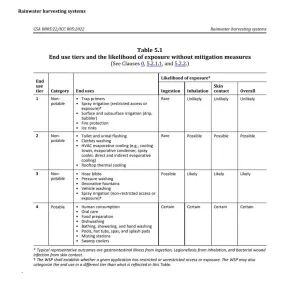
Water Treatment Guidance

Water Treatment Standards
Conclusion
The best treatment system is not necessarily the one with the most equipment. Instead, the ideal system is the one that meets the necessary water quality standards, protects public health, satisfies regulatory requirements, and remains affordable to operate and maintain.
For applications such as toilet flushing and underground irrigation, a preferred starting point typically includes biological treatment, filtration, UV disinfection, and a small chlorine residual for situations where ongoing protection is needed in storage or piping. Ozone treatment should be considered only when a specific water quality issue warrants the additional cost and complexity.
In many cases, a simpler, well-engineered system can be more effective than an expensive setup with unnecessary treatment processes.